
How to Store
Steel Bars, Rods,
and Beams Safely
in Your Warehouse
Steel bars, rods, and beams are among the most demanding materials to store safely in an industrial warehouse — heavy, long, and potentially lethal if a storage system fails. This guide covers the right rack specification, layout planning, and safety requirements for steel storage done correctly.
Why Steel Requires a Different Storage Approach
Steel bar stock, structural steel, and heavy rod materials present storage challenges that are fundamentally different from most warehouse materials. Understanding these differences is the starting point for any correct storage solution.
Exceptional Weight Density
A single bundle of 1-inch round carbon steel bar in a 20-foot length weighs approximately 2,700 lbs. A bundle of 4-inch square bar in 20-foot lengths can exceed 12,000 lbs.
Most warehouse storage equipment is designed around pallet loads of 2,000–4,000 lbs. Steel bar bundles routinely exceed these weights, meaning standard warehouse storage systems are structurally inadequate for steel storage — and loading them with steel creates an immediate safety hazard.
Length and Rigidity
Standard mill lengths for carbon steel bar and structural steel run from 10 feet to 40 feet. Unlike lumber, which can flex slightly without damage, steel is rigid and unforgiving.
Improper support along the length of a steel bar creates bending stress in the material itself — permanently deforming it and reducing its grade-level value. A single mishandled bar bundle can result in $500–$5,000 in material write-off.
Grade Identification Criticality
Steel is sold by grade — A36, 1018, 1045, 4140, stainless grades, aluminum grades. A mis-pick of the wrong grade, delivered to a fabricator or machinist, can result in part rejection, production halts, and contract penalties that far exceed the value of the material itself.
Organized, labeled storage that makes grade identification fast and reliable is not just an efficiency issue — it is a quality control requirement.
Forklift and Crane Access Requirements
Steel bar and structural steel are virtually always handled by forklift or overhead crane, never manually. This means the storage system must be designed to accommodate the specific equipment being used — whether that is a counterbalanced forklift with long forks, a side-loader, or a magnetic crane.
Standard aisle dimensions designed for standard pallet racking are frequently inadequate for steel material handling.
Why Floor Stacking of Steel Is Dangerous and Expensive
Despite the well-understood risks, floor stacking remains common in steel environments. The reasons are understandable — it requires no capital investment, no installation, and no planning. The costs, however, are substantial:
| Problem | Operational and Financial Consequence |
|---|---|
| Material damage from improper support | Steel bars stored directly on the floor develop surface corrosion at ground contact points and can develop bow or set if supported at insufficient intervals. Damaged steel is downgraded or scrapped.Material write-off |
| Roll-out and tip-over hazard | Round bar, pipe, and tube are highly prone to rolling off inadequate supports. A single 3-inch bar in a 20-foot, 800-lb bundle rolling off a stack creates a fatal crush hazard. Floor-stacked steel is an OSHA citation waiting to happen.Fatal hazard |
| Grade mix contamination | When multiple steel grades are stored in adjacent floor stacks, grade mix-ups are inevitable. Grade contamination in fabrication environments costs an average of $2,000–$15,000 per incident in rework and production delay.$2K–$15K / incident |
| Forklift retrieval time | Retrieving specific lengths and grades from floor-stacked steel requires moving multiple overlying bundles to access the target material. Retrieval times of 30–90 minutes per pick are common in disorganized steel storage areas.30–90 min/pick |
| OSHA compliance exposure | OSHA 29 CFR 1910.176(b) requires materials be stored to prevent tipping, rolling, or collapse. Floor stacking of round and structural steel frequently violates this standard.$15,625–$156,259 / citation |
Heavy-Duty Structural Cantilever Rack for Steel Storage
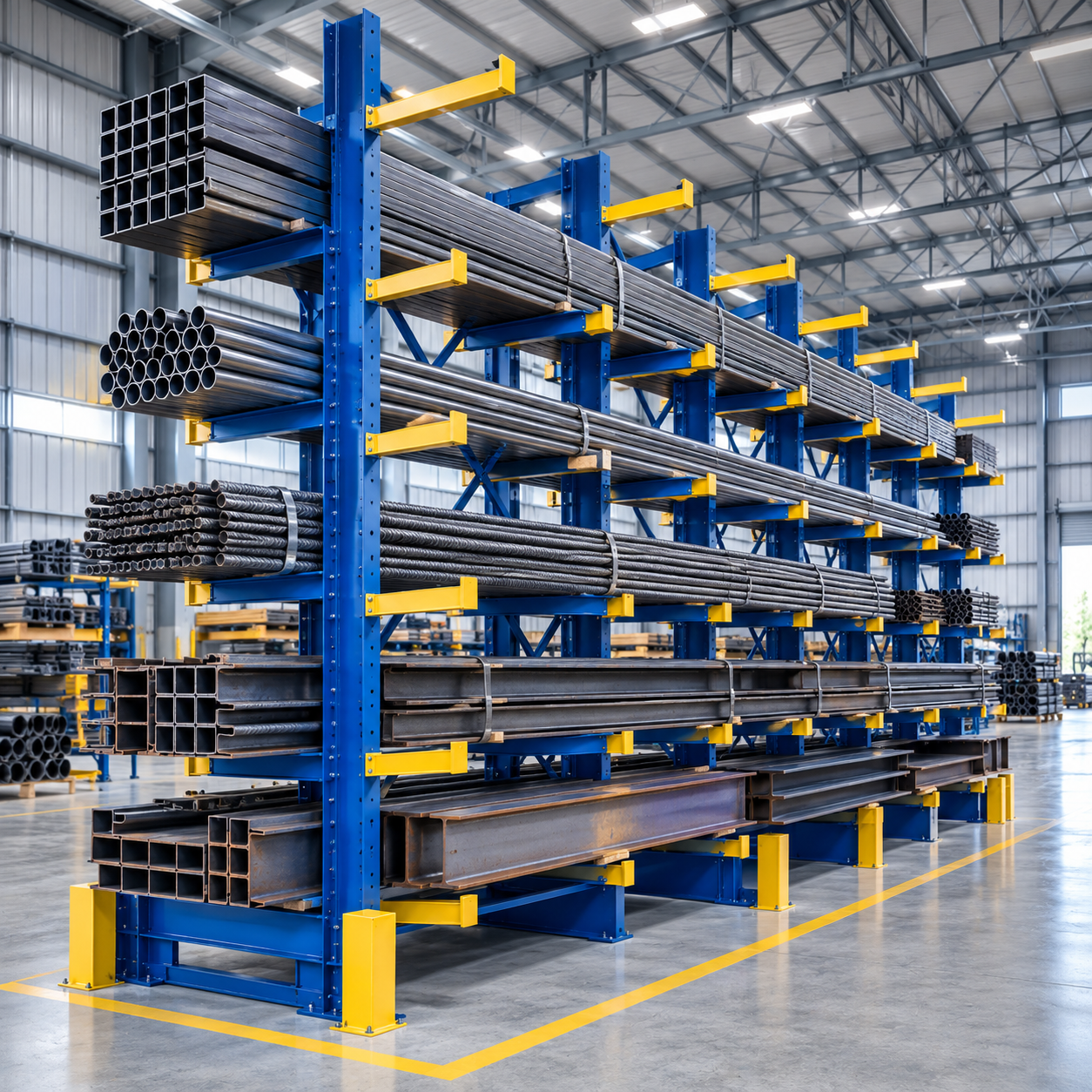
The purpose-designed storage solution for steel bars, rods, beams, and structural shapes is a heavy-duty structural cantilever rack system. Here is why — and what separates a correctly specified system from an inadequate one.
The Design ReasonWhy Cantilever Rack — Not Pallet Rack or Shelving
Cantilever racks have no vertical front columns obstructing the arm storage face. This open-front design allows forklifts, side-loaders, and cranes to approach from any direction and lift material cleanly without maneuvering around obstructions.
For steel bar bundles in 20–40 foot lengths, this unobstructed access is not a preference — it is a physical necessity. Standard pallet racking cannot accommodate long materials at all. Standard shelving cannot handle the arm loads generated by steel bundles. Cantilever rack is the only purpose-designed, structurally rated solution for steel storage.
The Specification RuleSteel Storage Always Requires Structural
For steel bar, structural steel, and heavy rod storage, a structural cantilever rack is the only appropriate specification. Roll-formed systems rated for 500–2,000 lbs per arm are inadequate for most steel storage applications:
- 1" round bar bundle, 20 ft = ~2,700 lbs — already exceeds most roll-formed maximum
- Structural steel bundles routinely reach 3,000–12,000 lbs per arm position
- Steel environments have high forklift impact exposure — structural rack withstands impact that deforms roll-formed systems
- Humid industrial atmospheres require galvanized structural rack in many environments
Structural Cantilever Rack Specifications for Steel Storage
Getting the specification right is the most important step in a steel storage rack project. These guidelines apply to typical steel bar and structural steel storage applications:
| Specification Element | Guidance for Steel Storage |
|---|---|
| Arm capacity per arm | Specify the maximum weight that will ever be placed on a single arm — including a 20–25% safety factor. For steel bar bundles, arm capacities of 3,000–8,000 lbs are typical. For heavy structural steel, 5,000–12,000+ lbs per arm may be required. |
| Arm length | Select the minimum arm length that provides full support for your longest material with at least 6–12 inches of safe overhang. For 20-foot bars, arm spacing of 4–8 feet with 24–36 inch arm lengths is typical. Unnecessarily long arms increase cost and reduce rated capacity at the tip. See correct arm length guidance. |
| Arm spacing (vertical) | For steel bar storage, arm spacing of 4–8 feet (vertical distance between arm levels) prevents excessive sag in the middle of long bundles. Heavier and smaller-diameter material requires closer arm spacing. Avoid excessive cantilever arm deflection by matching spacing to material stiffness. |
| Column height | Specify sufficient column height for the number of arm levels required, plus clearance for the tallest material bundle plus forklift carriage height. Most steel storage applications use column heights of 10–20 feet. |
| Single vs. double-sided | Double-sided units provide significantly more storage per footprint and are the standard configuration for freestanding steel storage aisles. Single-sided units are used against walls or at end-of-row positions. |
| Finish | For indoor steel service center environments, premium powder coat is adequate. For outdoor pipe yards, steel scrap yards, or humid environments, hot-dip galvanized coating is required for corrosion resistance. |
| Anchoring | All columns must be anchored to concrete floors with anchor bolts meeting the manufacturer's base plate specification. This is an OSHA requirement, not a recommendation. For heavy structural steel loads, confirm anchor bolt specification with your supplier. |
Storage Configuration by Steel Material Type
Different steel product forms require slightly different rack configurations. Here is how to match the rack specification to your specific materials:
Bar stock is typically the heaviest stored material per arm and requires the highest arm capacity ratings. For round bar, use flat cradle arms or arms with bar separators to prevent rolling. Arm spacing of 4–6 feet prevents sag in long bar bundles. FIFO rotation is important for bar stock to avoid grade aging on older bundles trapped behind newer deliveries.
Structural steel is typically longer and heavier per bundle than bar stock. I-beams and channels are often stored on their web (horizontally) to allow stable arm support without tipping. Angles and tubes store best in dedicated arm positions with side guides to prevent lateral shifting. For large structural shapes over 20 feet, consult a structural engineer on column spacing and arm support design.
High-alloy and tool steel grades require the same structural capacity as carbon steel but have additional requirements for grade identification and segregation. Each arm position should store only a single grade to prevent grade contamination. Consider color-coding arm positions by grade group, or using a dedicated labeling system integrated with your inventory management system.
Stainless steel must be stored away from carbon steel to prevent carbon contamination that degrades corrosion resistance. Dedicated stainless steel rack sections, ideally in a separate aisle or area, prevent cross-contamination. Arm surfaces that contact stainless steel should be coated, rubber-lined, or plastic-capped to prevent galvanic corrosion and surface marking.
Aluminum bar and extrusions are significantly lighter than steel but still require cantilever racking for organized, accessible storage of long lengths. Roll-formed cantilever systems rated for 1,000–2,000 lbs per arm are typically adequate for aluminum unless bundle weights are unusually high. Like stainless, aluminum must be segregated from carbon steel to prevent contamination.
Warehouse Layout Planning for Steel Storage
Effective steel storage is as much about layout design as rack specification. Here is how to approach the four key layout planning decisions:
Aisle Width Planning
The aisle width between double-sided cantilever rack rows must accommodate the material handling equipment plus the length of the material being handled.
For a side-load truck carrying 40-foot material, the effective working aisle may need to be 14–18 feet wide. For counterbalanced forklifts handling bundles up to 20 feet, aisles of 12–16 feet are typical.
FIFO vs. Random Access
For steel distributors where inventory rotation is critical, consider drive-through aisle configurations that force FIFO picking discipline.
For service centers where specific lengths and grades need to be pulled regardless of stacking order, front-access double-sided rows with clear end-of-aisle identification allow faster picking without rotation constraints.
Proximity to Loading & Processing
Position steel rack rows as close as practical to receiving docks and processing equipment. Every additional 100 feet of travel distance for a forklift carrying a steel bundle adds 30–60 seconds of retrieval time per pick.
At 40 picks per day in a busy service center, a 200-foot layout inefficiency costs 20–40 minutes of forklift time daily.
8 Safety Requirements for Steel Bar and Beam Storage
Steel storage is one of the highest-risk material handling environments in industrial warehousing. The following are mandatory requirements for OSHA compliance and operational safety:
All columns anchored to concrete floors per OSHA 29 CFR 1910.176 and RMI/ANSI MH16.3 — no exceptions, no temporary installations. For heavy structural steel loads, confirm anchor bolt specification with your supplier before installation. Unanchored systems are a common and costly installation mistake. OSHA 29 CFR 1910.176
Load capacity placards posted on every bay showing maximum arm load in lbs or kg — required by OSHA 29 CFR 1910.176(e). Placards must be visible from the forklift operator's loading position and replaced immediately if damaged. Required by law
Arms never loaded beyond their rated capacity — even short-term overloading creates permanent arm deformation and cascading failure risk. Review arm capacity ratings whenever product mix or bundle weights change. RMI/ANSI MH16.3
Column protectors installed at all aisle-facing column positions — steel handling equipment operates at speeds and with payloads that make forklift impacts particularly destructive in steel storage areas. End-of-aisle columns are especially vulnerable. General Duty Clause
Round bar and tube stored with end stops or bar separators to prevent roll-out — the primary fatal hazard in steel storage is material rolling off an arm position. Never rely on bundle weight alone to prevent roll-out. Fatal hazard prevention
No unauthorized stacking of additional material on top of racked material — adds unrated load to the arm and column system, eliminates forklift access, and creates an unstable secondary load above workers. OSHA 29 CFR 1910.176
Annual formal rack inspection per RMI/ANSI MH16.3 standards plus informal monthly visual inspections. Steel storage systems receive high forklift impact exposure and require more frequent inspection than standard warehouse rack. Consider semi-annual formal inspections for busy service center environments. RMI/ANSI MH16.3
Post-impact inspection immediately following any forklift collision with rack columns or arms — remove system from service if structural damage is found. No steel storage rack should be returned to service after a significant impact without a qualified person's inspection and sign-off. Required — no exceptions
Frequently Asked Questions
Questions steel distributors, service centers, and fabrication shops ask most frequently about cantilever rack for steel storage.
What type of cantilever rack is required for heavy steel bar storage?
Heavy-duty structural cantilever rack is required for steel bar, rod, and beam storage. Roll-formed cantilever rack (rated for 500–2,000 lbs per arm) is inadequate for most steel storage applications, where bundle weights routinely range from 2,000 to 12,000+ lbs per arm. Structural cantilever racks are rated for 2,000–10,000+ lbs per arm and are the correct specification. Request a free consultation for a system sized to your loads.
How many arms do I need per bay for steel bar storage?
The number of arm levels per column depends on the height of stored material, the arm spacing required to prevent sag, and your column height. For 20-foot bar stock with 6-foot arm spacing, a 20-foot column provides 3–4 arm levels per face. Your supplier should review your specific material profile and column height to recommend the right arm level count.
How wide should aisles be for a steel service center rack layout?
Aisle width depends on your specific material handling equipment. Side-load trucks handling 40-foot material typically require 14–18 foot aisles. Counterbalanced forklifts handling 20-foot bundles typically require 12–16 foot aisles. Always confirm with your forklift specifications and add a safety margin of at least 24 inches beyond the calculated minimum.
Can I store different steel grades on the same cantilever rack system?
Yes — different grades can be stored on the same rack system in separate arm positions. Each arm position should store only one grade to prevent grade contamination. A clear labeling system is essential. For stainless steel and aluminum, separate racks in segregated areas are strongly recommended to prevent cross-contamination with carbon steel.
How do I prevent round bar from rolling off cantilever rack arms?
Use arms with integral bar separators, rubber-covered arm surfaces, or end stops that prevent round bar and tube from rolling off the arm tip. Ensure that the outermost arm tip has some form of physical stop for any round or tubular material. Never rely on bundle weight alone to prevent roll-out — this is the primary fatal hazard in steel storage.
What is the best way to label and identify steel grades in a rack system?
Use durable, weather-resistant labels at each arm position showing grade, size, and arm load limit. Color-coding by grade group adds a visual confirmation layer that reduces mis-picks. Integrate arm position labels with your warehouse management system or ERP using location codes that enable pick routing and inventory tracking.
Do I need a permit to install heavy-duty structural cantilever rack?
Indoor rack installations on existing concrete slabs typically do not require building permits. However, very heavy rack systems may require a structural engineering review to confirm the concrete floor's load-bearing capacity. Outdoor installations on new foundations require permits in most jurisdictions. Confirm requirements with your local building department before proceeding.
How often should heavy-duty steel storage racks be inspected?
Annual formal inspections per RMI/ANSI MH16.3 plus monthly informal visual inspections are the minimum standard. Steel storage environments experience high forklift impact frequency and heavy loads — consider semi-annual formal inspections for busy service center environments. Always conduct an immediate inspection after any forklift impact event, no matter how minor it appears.
Get a Free
Steel Storage
Consultation
Cantilever Rack Supply has designed heavy-duty structural cantilever rack systems for steel distributors and service centers for over 18 years. Tell us your material types, bundle weights, and warehouse dimensions — we will recommend the right specification and provide a fully itemized quote at no obligation.